

Ecommerce customer service is everything that happens after a shopper has a question: where their order is, whether the blue one is back in stock, and whether anyone will reply before they buy somewhere else. Nearly every guide on the subject assumes you have a support team, a help desk and a queue to move work between. This one is written for the far more common store, where customer service is you, on your phone, at eleven at night. It covers which questions actually eat the time, which of them an AI agent can answer from your own catalog and policies, which ones should stay with you, and how to tell within a month whether it worked.
Ultimo Bots is an AI agent for any online store: it answers from your own product catalog, policies and pages around the clock on your website, a shareable chat link, Messenger, Instagram, Telegram and Slack, captures the enquiries worth following up, hands the hard ones to you in the same window, and connects to HubSpot, Mailchimp or a Zapier, Make or n8n workflow so the work behind an answer runs on its own.
What ecommerce customer service means when you are the team
Search for ecommerce customer service and you will be told to define your service channels, document your escalation paths and measure first response time across your agents. That advice is not wrong. It is written for a company that has agents.
When the store is you, the shape of the problem is different. There is no queue, because everything arrives directly: the site chat, the Instagram DM, the email you read in bed. There is no escalation path, because you are the escalation. And the cost is not headcount, it is attention. One of the most discussed results on that first page is somebody asking how other people handle customer service as "a massive time sink" for a small store, which is the honest version of the question.
So the useful goal is not better service coverage. It is this: the questions you have already answered a hundred times stop reaching you, and the ones that genuinely need you still do.
The five questions that eat the day
Almost all of the volume in a small store sits in five questions, and they are worth tackling in this order, because that is the order in which they pay back.
- Where is my order. The single most common message any store receives, usually sent within a day of an email that already answered it. It is pure repetition and it never stops.
- Do you have this in another size or colour, and is it in stock. Time sensitive: a shopper asking this is holding a card. An answer an hour later is a lost sale, not a support ticket.
- What is your returns policy. Asked before purchase far more often than after. It is on your site already, and people still ask, because they want it confirmed by someone.
- How much is shipping and how long does it take. Varies by country and by basket, which is exactly why people ask instead of reading.
- Which one should I get. The question you would most like to answer personally and have the least time for, and the one most likely to end in a sale.
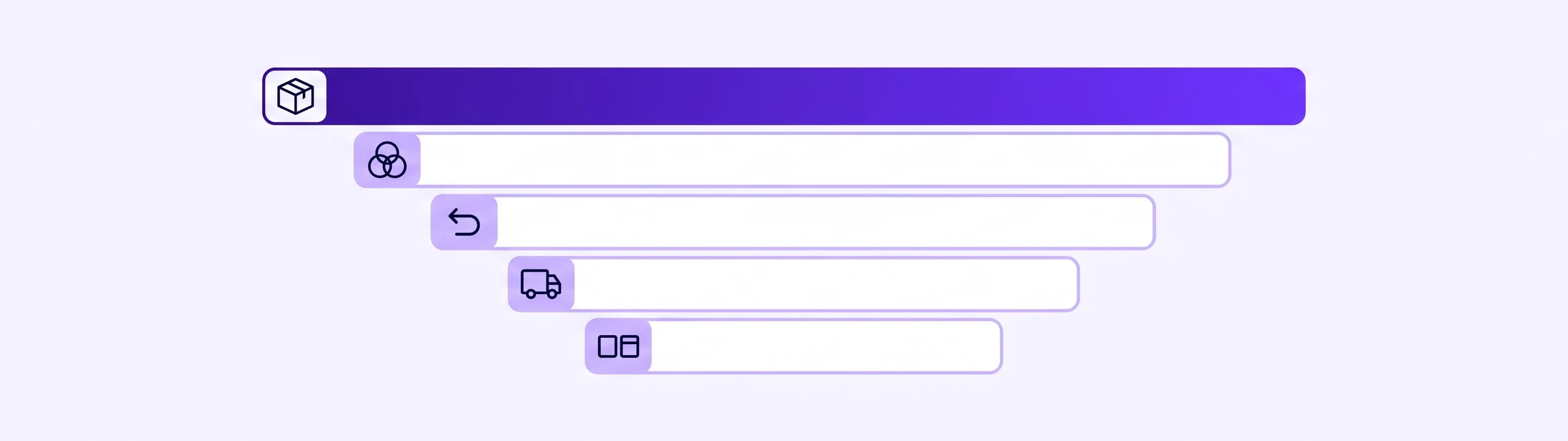
Notice what the first four have in common: the answer already exists, in your policy pages, your catalog or your order data. None of them needs a person. They need someone available at the moment they are asked.
What an AI agent can answer from your own store
An AI agent reads the material you already have and answers from it, in the shopper's own words, in the language they wrote in. In practice that means four sources.
Your pages and files. Shipping, returns, sizing, care instructions and payment methods come from your website, uploaded documents, a Google Drive or OneDrive folder, or a Notion workspace, and are re-read on a schedule so an answer never lags a policy change. This is the knowledge base behind every reply, and answers arrive with the source they were drawn from rather than a confident guess. It is self service that actually answers, instead of a help centre the shopper has to search.
Your catalog. Products load with their variants, prices and stock, so "is the blue one back" gets a real answer instead of a link to a category page. Wix and Shopify stores mirror themselves automatically. Any other store loads from a CSV, JSON or TSV export of your catalog.
Your order data. Order status is the one answer that has to come from live data, and the shopper has to prove who they are first. On a Wix store the agent can look up an order and its shipment itself, once the shopper has confirmed their email address with a six-digit code, so nobody reads someone else's order by guessing a number. On any other store the agent can send the order number to a Make or n8n workflow and read the reply back into the same message.
Your own instructions. Anything that is not written down anywhere, like the fact that you ship to Switzerland but not to the UK this month, you tell the agent in a sentence and it holds to it.
The last one matters more than it sounds. On a Shopify store the agent goes further than answering: it searches the live catalog, puts the item the shopper settled on into the real storefront cart, and hands over a checkout link, so the conversation that started as a support question finishes as an order.
What support services are available for e-commerce?
Advice about customer service for ecommerce tends to jump straight to tooling. There are really four options, and the right one depends far more on whether you have staff than on the size of your catalog.
| Option | What it is | What it costs | Who it suits |
|---|---|---|---|
| A help desk | Shared inbox, tickets, agent assignment. Gorgias, Zendesk and the rest | Per agent seat, per month, sometimes per resolved conversation on top | Stores with two or more people whose job is support |
| Outsourcing | You outsource to trained humans, billed by the hour or the ticket | Hourly or per ticket, plus onboarding and a brief you have to write | Stores with steady volume and margin to hand over |
| An AI agent | Software that answers from your own content and hands over to you | A flat monthly plan, with no per-seat charge because there are no seats | Stores where customer service is one person doing it between other jobs |
| Nothing | The inbox, whenever you get to it | Free, and paid for in lost sales and evenings | Nobody, for long |
The reason a help desk feels wrong for a one-person store is not the price, it is the shape. A ticketing system is a tool for moving work between people. With one person there is nowhere to move it to, so you get the admin of a support department without the relief of one. Ecommerce customer service software priced per seat quietly assumes the seats exist.
Where your shoppers actually message you
A shopper who found you on Instagram will ask on Instagram. The same agent, with the same catalog and the same policies, answers on your website chat, on a shareable chat link you can put in a bio or an order confirmation, in Facebook Messenger, in Instagram DMs, in Telegram and in Slack. There is no separate setup or separate content per channel, and no channel that costs extra.
That also fixes the quiet problem with social selling: DMs arrive at the worst possible times and get answered last. An agent that already knows your stock answers them at 2am, in the language the shopper wrote in.
When the answer needs more than words
Some questions end in work rather than in a sentence, and this is where an agent stops being a nicer FAQ page. Through app actions it can send what it collected to a workflow you own, so the follow-up happens without you touching it.
- A wholesale enquiry at midnight becomes a contact in HubSpot and a confirmation mail to the shopper, before you have read it.
- A "tell me when it is back" request adds the shopper to a Mailchimp audience and drops the product in a spreadsheet you check on restock day.
- A damaged delivery posts to a Make or n8n workflow that opens the case, files the photos and answers the shopper with the case number in the same reply.
One practical difference is worth knowing before you build anything: Make and n8n can both send a response back to whatever called them, so the agent can tell the shopper what happened. Zapier only receives, which makes it the right choice when the workflow runs behind the scenes and the shopper does not need the answer back.
Everything the agent collects along the way lands in the lead inbox with the conversation attached, so you see what was asked before you reply.
The questions that should stay with you
Automation without an exit turns a mildly annoyed customer into a former one, so the handoff is a feature rather than a fallback. Four kinds of message deserve a person, and an agent that knows this is worth more than one that tries everything.

An order that arrived broken. A shopper who is already angry. Anything involving money moving back: the agent can explain your returns policy and take the details, but the refund itself stays your decision. And the one-off judgment call, the wedding on Saturday and the dress that has not shipped.
For all four, the shopper asks for a person and you appear in the same window, on the same live chat, with the whole conversation already in front of you. On Boost and Ultimo the AI can draft a suggested reply for you, and on every paid plan messages in a language you do not read are translated both ways, which for a store that ships internationally is the difference between answering and apologising. When you are closed, the agent says so and takes a message rather than pretending.
The agent also tells shoppers it is an AI assistant, without you configuring anything. That makes the handoff work better, because people who know they are talking to software ask for a person sooner and are less annoyed when they do.
What it costs
Every plan includes every channel, the human handoff and the app actions. The difference is how many AI replies you send and how much of your own material the agent reads.
| Plan | Monthly | Yearly, per month | AI replies per month | Knowledge sources |
|---|---|---|---|---|
| Smart | $29 | $19 | 500 | 200 |
| Boost | $59 | $39 | 2,000 | 1,000 |
| Ultimo | $149 | $99 | 10,000 | 10,000 |
For most small stores the entry plan is the right one, and 500 replies a month is roughly seventeen conversations a day. If a launch or a seasonal peak takes you past the allowance, extra reply packs start at $19 for 500 and stay valid for twelve months, so a busy November does not push you onto a bigger plan for the rest of the year. Every plan has a seven day free trial and the full pricing is public, which is more than most of page one will tell you before a demo call.
How to tell it is working after a month
Three signals, all of which you can check yourself without a dashboard.
Count how many of the five questions still reach you. Not the total number of conversations, which will go up. Count the repetitive ones landing in your own inbox. If "where is my order" is down by half, that is the whole business case.
Read the handoffs, not the successes. Every conversation the agent passed to you is either a question it should have known, which means something is missing from your content, or a genuine judgment call, which means it worked. That ratio tells you what to fix.
Watch the hour stamps. Look at the conversations answered between six in the evening and nine in the morning. Those are the shoppers you were previously losing to whoever replied first.
For a store this size, ecommerce customer support is not really a software category. It is the hours a week you get back and the sales you stop losing at night, and both are measurable within a month.