

EU AI Act Article 50 is the transparency rule of the European Union's AI regulation, and it has applied since 2 August 2026. The core requirement for websites is short: when an AI system interacts with people they must be told, so if an AI agent answers visitor questions on your site, that duty now covers every one of those conversations. Ultimo Bots customers do not need to build anything for this: the visitor-facing notice is already part of the product, appears in the visitor's own language, and cannot be switched off.
Ultimo Bots is an AI support agent for any website that answers visitors from your own content, discloses itself as AI by design, and hands the conversation to a human when needed.
What EU AI Act Article 50 requires

The EU AI Act sorts AI systems by risk. A few practices are banned outright, high-risk systems such as credit scoring or hiring tools face strict requirements, and AI that talks to people sits in the transparency tier, often called limited risk. A support agent on a company website lives in that third group: allowed without any approval process, but visitors must know they are talking to AI.
Article 50(1) puts the duty into one sentence: providers must design AI systems that interact directly with people so that those people are informed they are interacting with AI. There is one exception, when this is already obvious to a reasonably well-informed and observant person. The European Commission's guidance on the transparency obligations reads that exception narrowly, so the safe assumption for a normal business website is that the notice is required.
The same guidance is specific about timing and form: the information must come at the start of the first interaction, in a clear and distinguishable way, and it must meet accessibility requirements. A sentence buried in the privacy policy does not meet that bar. A visible notice in the chat itself does.
Article 50 also covers machine-readable marking of AI-generated media, labels for deepfakes, and notices for emotion recognition systems. Those matter if you publish synthetic content, but for a website support agent, paragraph one is the part that concerns you. The full legal text is on the EU AI Act explorer.
Who does the EU AI Act apply to?
The Act separates providers, the companies that build and sell AI systems, from deployers, the businesses that use them. The disclosure requirements for a conversational AI sit with the provider: the system must be designed so that people are informed. As a website owner you are the deployer. The practical consequence is friendly: pick a provider whose product discloses by default, and there is nothing to retrofit on your side.
Geography does not offer an exit either. The Act applies to providers placing AI systems on the EU market wherever they are established, and it reaches businesses outside the EU when the output of an AI system is used in the Union. A US or Swiss company whose website chats with visitors in France is in scope.
There is no small-business exemption. Fines for transparency violations can reach 15 million euros or 3 percent of worldwide annual turnover, with proportionality for small and medium-sized businesses. For a small company the relevant fact is not the ceiling. It is that the obligations are now enforceable, and that compliance for a website agent is cheap if your tools do it for you.
Key EU AI Act dates for website owners
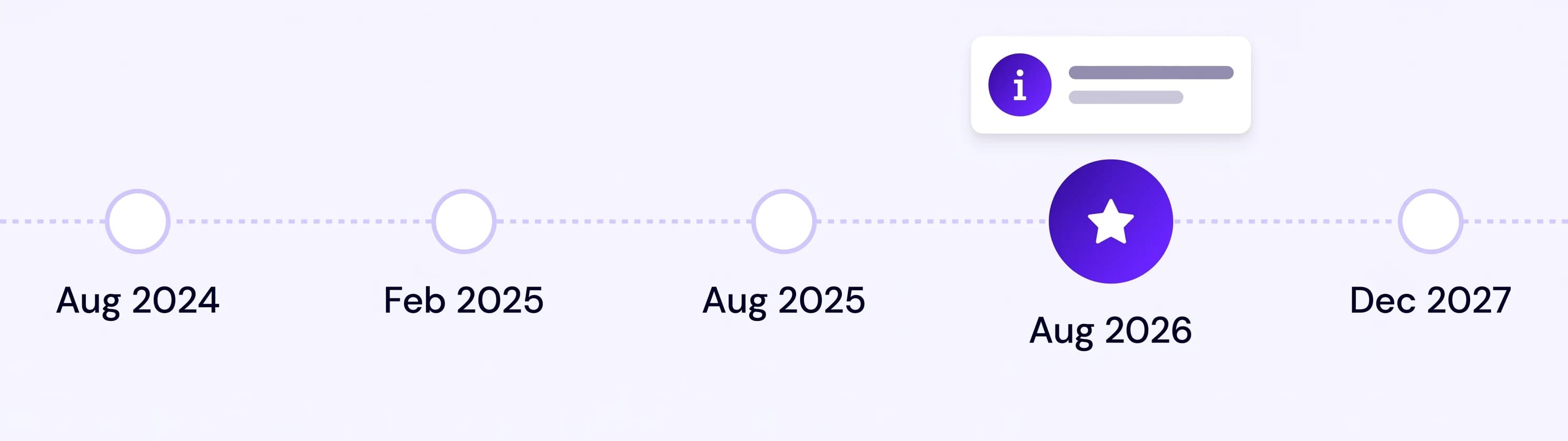
The AI Act arrived in stages, which is why the deadlines confuse people. The implementation timeline in one view:
| Date | What applies |
|---|---|
| 1 August 2024 | The AI Act entered into force. Obligations phase in over the following years. |
| 2 February 2025 | Bans on prohibited AI practices, plus the AI literacy duty for teams working with AI. |
| 2 August 2025 | Rules for general-purpose AI models and the penalty framework. |
| 2 August 2026 | Most remaining provisions, including the Article 50 transparency obligations. |
| 2 December 2026 | End of the grace period for machine-readable marking by generative systems already on the market. |
| 2 December 2027 | Obligations for stand-alone high-risk systems (Annex III), postponed by the Digital Omnibus. |
| 2 August 2028 | High-risk AI embedded in regulated products such as medical devices or machinery. |
Two things caused confusion this summer and are settled now. The Digital Omnibus, the first major amendment to the AI Act, published in the Official Journal on 24 July 2026, pushed the high-risk deadlines back but left the transparency obligations untouched: Article 50 applies unchanged since 2 August 2026. If this month is the first time the Act has crossed your desk, focus on one row: since 2 August 2026, EU AI Act Article 50 and the other remaining provisions are in force, and the transparency rules are the part that concerns a normal business website.
How Ultimo Bots shows the AI notice automatically
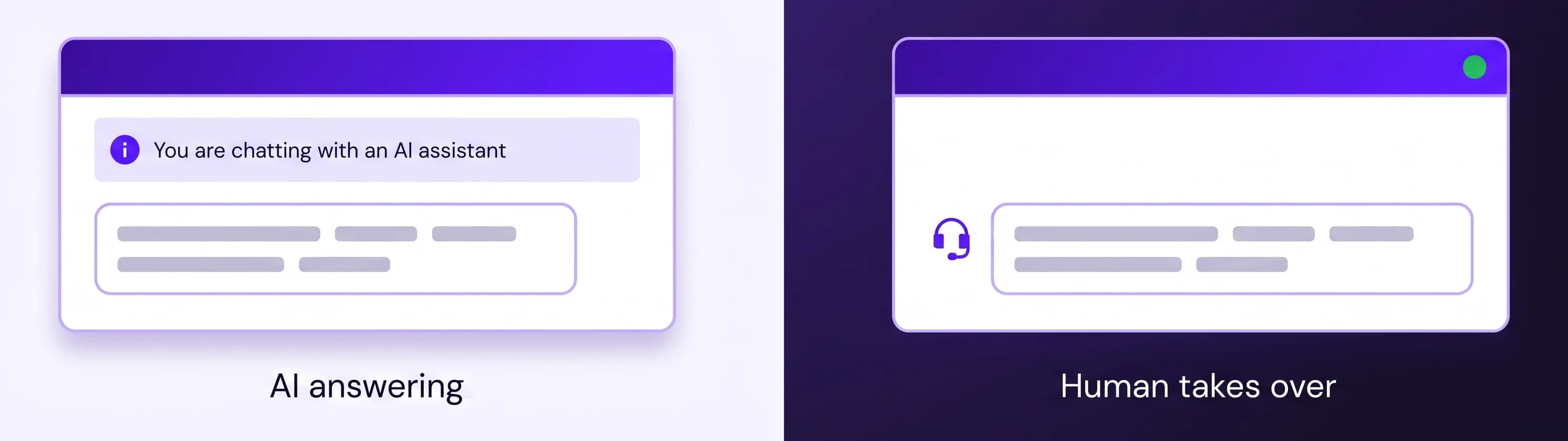
Every Ultimo Bots chat carries a notice directly under the chat header: "You are chatting with an AI assistant". We shipped it ahead of the August 2026 date, and it behaves the way the rule expects:
- Visible from the first moment. The notice is on screen as soon as the chat opens, before the visitor types anything. Article 50 asks for information at the start of the first interaction, not somewhere along the way.
- In the visitor's language. The notice follows the visitor's browser language across eight languages, with English as the fallback. A French visitor on a German site reads it in French, without the site owner configuring anything.
- Not optional. There is no setting to hide it. It is also independent of the "Powered by" branding, so paid plans that remove branding keep the AI notice.
- Honest in both directions. When a real person takes over through live chat handoff, the notice steps aside, because "you are chatting with an AI assistant" would then be false. It returns when the AI answers again.
- No pretending. The agent is built as an AI assistant and presents itself as one when asked. It answers from your own website knowledge base rather than improvising, and it never claims to be a human colleague.
The same notice ships on the website chat and the hosted chat page, no matter which website builder or stack your site runs on. There is no banner to build, no plugin to add, no text to translate.
What stays your responsibility
"The tool handles it" is never the whole story with regulation, so here is the honest list of what remains on your side:
- Messaging channels. The automatic notice covers the chat surfaces on your website. If you also connect Facebook Messenger, Instagram or Telegram, add a short AI mention to the greeting there. One sentence does it.
- AI literacy in your team. Since February 2025, businesses are expected to make sure people working with AI understand what it does and where it fails. A short internal note covering which AI tools you use and their limits is a reasonable start for a small team.
- Your other AI output. If you publish AI-generated images, audio or articles, those carry their own marking and labeling duties under Article 50, separate from the chat.
- Privacy. GDPR did not go anywhere. Ultimo Bots operates GDPR-aligned with European data handling, and your own privacy policy obligations continue as before.
This is practical guidance, not legal advice. If your AI does more than answer support questions and capture leads, for example anything touching credit, hiring or health decisions, talk to a lawyer about the high-risk categories.
A two-minute transparency check for your website
- Open your site in a private tab and start a chat. Within the first interaction, is it clear that AI is answering?
- Change the chat's colors and branding, then check again. The AI notice should survive every customization.
- Switch your browser to another language and reload. Visitors should get the notice in their own language.
- Ask for a human. The handoff should exist, and it should stay honest about who is talking at every step.
- List your AI touchpoints beyond the website, such as messaging channels and generated content, and give each its own disclosure.
With Ultimo Bots, points one to four are the default. Run the check anyway. It takes two minutes, and you will see your chat the way a visitor, and if it ever matters, a regulator, sees it.
Transparency rules usually arrive with groans, but this one rewards honest businesses. Visitors already assume AI answers some of their questions. The companies that lose under Article 50 are the ones whose AI pretended to be a colleague named Sarah. If your agent is useful, disclosure costs you nothing: visitors get instant answers, and they know exactly who is answering.