

Customer service outsourcing means paying an outside provider to answer your customers for you, billed by the hour, by the ticket or by the dedicated agent, usually with a monthly minimum underneath it. It is a strong answer to one specific problem: steady volume that somebody has to work through. It is an expensive answer to a different problem, which is the same handful of questions arriving over and over, and that is the problem most small businesses actually have. This is a straight look at what outsourcing costs, when it earns its money, and what to do first when your volume is repetitive rather than large.
Ultimo Bots is an AI agent for any business website: it answers from your own pages, documents and policies around the clock on your site, a shareable chat link, Facebook Messenger, Instagram DMs, Telegram and Slack, captures the enquiries worth following up, hands the ones that need you into a live chat in the same window, and connects to HubSpot, Mailchimp or a Zapier, Make or n8n workflow so the work behind an answer runs on its own.
Cover your inbox without hiring
What customer service outsourcing actually costs
You will notice something on the first page of results for this term: almost nobody publishes a price. Providers ask you to book a call, and the listicles rank customer support outsourcing companies by scalability and quality assurance rather than by cost. That is not evasion, it is how the pricing works. The quote is built from your volume, your hours and your complexity, so there is no number to put on a page.
It is also sold under several names. Outsourced customer support, customer care outsourcing and call center outsourcing describe much the same arrangement, and the label mostly tells you which channel that provider grew up in.
There are four shapes it usually takes.
| Model | How it bills | Suits | What to watch |
|---|---|---|---|
| Per hour | A shared or dedicated agent, billed for time | Predictable daytime volume | You pay for the quiet hours too |
| Per ticket | A rate per conversation handled | Spiky, seasonal volume | Repetitive questions cost the same as hard ones |
| Per agent | A full-time person assigned to you | Steady load that keeps someone busy | The minimum commitment is usually months, not weeks |
| Per resolution | A fee only when a case closes | Volume with clear outcomes | What counts as resolved is defined in the contract |
Underneath whichever model you pick there are three costs that never appear in the headline rate. There is onboarding, because a stranger cannot answer as you until someone writes down how you answer. There is ramp time, the weeks where you are paying full rate for replies you still have to check. And there is the minimum, which is the part that decides the question for most small businesses: outsourced customer service solutions are built around a floor, and below that floor the maths simply does not work.
Is it cheaper to outsource customer service?
Cheaper than hiring your own support person, almost always. Cheaper than what you are doing now, which is answering everything yourself between other jobs, only sometimes.
The number that settles it is not your total volume. It is the share of your messages whose answer already exists in writing.
This is the part the outsourcing conversation skips. The cost of outsourcing customer service is priced against how many conversations you have. It is not priced against how many of them are the same conversation. Every repeat question you route to an outsourced agent is a person being paid by the hour to retype something that is already on your shipping page, and you are paying the same rate for that as for the message that genuinely needs a human being.
So before you take a discovery call, spend one week counting. Tag every incoming message with the question behind it. Most small businesses find that five or six questions carry the large majority of the volume, and that the answers already exist somewhere on their own site. If that is your week, you do not have a staffing problem. You have a repetition problem, and staffing is a costly way to solve it.
When outsourcing is genuinely the right call
It often is, and the case is worth stating plainly rather than argued away.
Outsource when the phone is the channel your customers actually use, because a call has to be picked up by a voice. Outsource when your volume is steady and high enough to keep a person genuinely busy, since that is exactly the load an hourly or per-agent rate is designed for. Outsource when the work needs judgement at scale, like claims, disputes or anything with a regulated script and an audit trail behind it. And outsource when you must cover hours or languages live that you cannot staff yourself, at a scale where handing off to nobody would be worse than the cost.
Seasonal peaks are the honest edge case. Ecommerce customer service outsourcing is pitched at exactly that shape, the November that runs at three times a normal month and is gone by January, and renting people for eight weeks is a sensible way to survive it.
If two or more of those describe you, get quotes from customer service outsourcing services and compare them properly. The rest of this is written for everybody else.
What an AI agent answers before anyone is billed
The fastest saving is not a cheaper person. It is removing the repeat questions from the queue entirely, so that nobody is paid to answer them at all.
An AI agent reads what you have already written and answers from it, in the customer's own words and in the language they wrote in. That material comes from three places.
Your pages and files. Shipping, returns, pricing, opening hours, specifications and policies come from your website, uploaded documents, a Google Drive or OneDrive folder, or a Notion workspace. It is re-read on a schedule, so an answer never lags a policy change, and this knowledge base is what every reply is drawn from rather than a confident guess.
Your own instructions. The things written down nowhere, like the fact that you ship to Switzerland but not to the UK this month, you say once in a sentence and the agent holds to it.
What it does not know. An answer that is not in your material is not invented. The conversation goes to you instead, which is the behaviour you would want from a new hire in week one.
Compare that with the onboarding cost above. A brief has to be written, reviewed and kept current by a person; your website already exists, and the agent starts from it on day one.
Where your customers actually message you
A customer who found you on Instagram will ask on Instagram, and an outsourced team is normally scoped to the channels you contracted for.
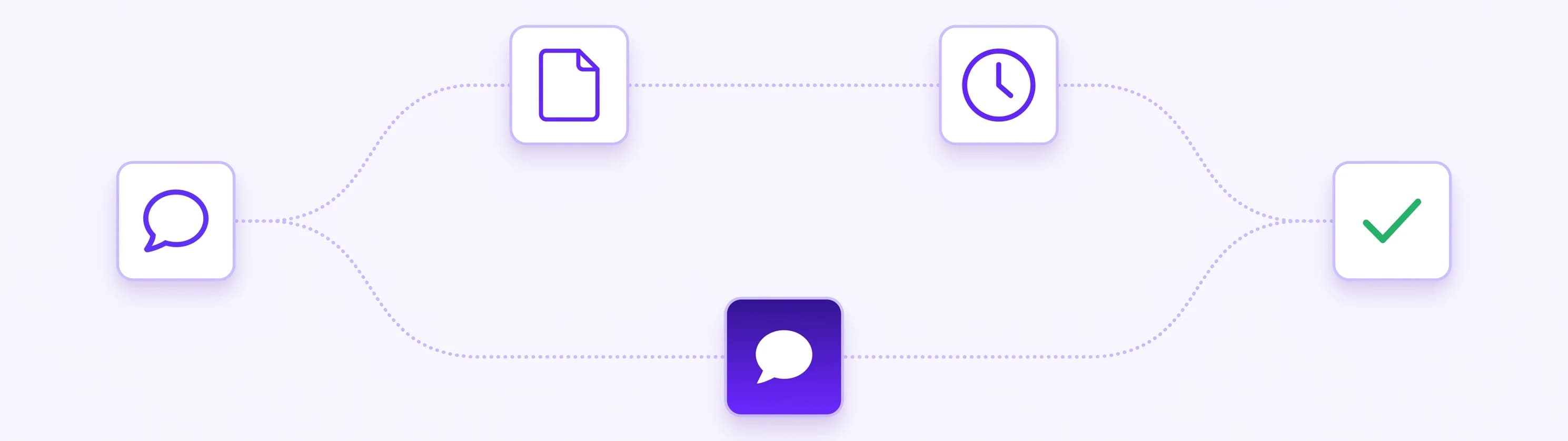
The same agent, with the same knowledge, answers on your website chat, on a shareable chat link you can drop into an email signature or a bio, in Facebook Messenger, in Instagram DMs, in Telegram and in Slack. There is no separate setup or separate content per channel, and no channel that costs extra.
It also does not have opening hours, which is where most of the messages a small business loses are actually lost.
When the answer needs work, not just words
The strongest argument for outsourcing is that a human can do things, not just say them. So can an agent.
Through app actions it sends what it collected to a system you own, so the follow-up happens without you touching it.
- A quote request at eleven at night becomes a contact in HubSpot with the details attached, and a confirmation mail to the customer, before you have read it.
- A "tell me when you have this again" adds the person to a Mailchimp audience and drops the item into a sheet you check on restock day.
- A booking enquiry posts to a Make or n8n workflow that checks availability and answers the customer with the slot in the same reply.
One practical difference is worth knowing before you build anything: Make and n8n can both send a result back to whatever called them, so the agent can tell the customer what happened. Zapier only receives, which makes it the right choice when the work runs behind the scenes and the customer does not need the answer back.
Everything the agent collects lands in the lead inbox with the conversation attached, so you see what was asked before you reply.
Let the routine work run itself
What still needs a person, and what that is worth
Automation with no exit turns a mildly annoyed customer into a former one, so the handoff is a feature rather than a fallback. It is also the honest limit of everything above.
Three kinds of message deserve you. Somebody who is already upset. Anything where money moves back to the customer, since the agent can explain the policy and take the details but the decision stays yours. And the genuine one-off judgement call, the wedding on Saturday and the order that has not shipped.
For all three the customer asks for a person and you appear in the same window, on the same live chat, with the whole conversation already in front of you. Messages in a language you do not read are translated both ways. When you are closed, the agent says so and takes a message rather than pretending. It also tells people it is an AI assistant without you configuring anything, which makes the handoff work better, because someone who knows they are talking to software asks for a person sooner and is less annoyed when they do.
What it costs
Every plan includes every channel, the human handoff, lead capture and the app actions. The difference between them is how many AI replies you send and how much of your own material the agent reads.
| Plan | Monthly | Yearly, per month | AI replies per month | Knowledge sources |
|---|---|---|---|---|
| Smart | $29 | $19 | 500 | 200 |
| Boost | $59 | $39 | 2,000 | 1,000 |
| Ultimo | $149 | $99 | 10,000 | 10,000 |
For most small businesses the entry plan is the right one, and 500 replies a month is roughly seventeen conversations a day. If a launch or a busy season takes you past the allowance, extra reply packs start at $19 for 500, are only used once the monthly allowance runs out, and stay valid for twelve months, so one heavy November does not push you onto a bigger plan for the rest of the year.
There is no per-seat charge, because there are no seats. Every plan has a seven day free trial, every trial includes a free setup call, and the full pricing is public, which is more than the first page of this search will tell you before a discovery call.
How to decide without signing anything
Almost everything written about customer service outsourcing for small business starts by helping you choose a provider. Start two steps earlier instead, because it costs almost nothing and it makes any quote you eventually ask for a better one.
Count for a week. Tag every message with the question behind it. You are looking for one number: the share that already has a written answer somewhere on your site.
Put that share on autopilot for a month. Whatever is left is your real support volume, and it is the only volume worth pricing.
Then get quotes, if you still need them. A provider pricing your genuine judgement calls is a far cheaper provider than one pricing your shipping-policy questions, and you will be able to read the proposal properly because you know what is in it.
After a month, three signals tell you whether it worked, and you can check all three yourself. Count how many repeat questions still reach you personally, which is the whole business case in one number. Read the conversations that were passed to you rather than the ones that went well, because each one is either something missing from your content or a genuine judgement call, and that ratio tells you what to fix. And look at the hour stamps on the answers between six in the evening and nine in the morning. Those are the customers you were previously losing to whoever replied first.
Outsourcing is not dying, and nothing here says it is. What has changed is where the floor sits. The repetitive majority of small business customer service no longer needs a person at all, so the work you would hand to an outsourced team is a much smaller and much more interesting pile than it was three years ago.